
Canada's wildland and forest firefighters are not classified as firefighters and it’s costing them their retirement.
Write a letter to your MP
Canada's wildland and forest firefighters are not classified as firefighters and it’s costing them their retirement.
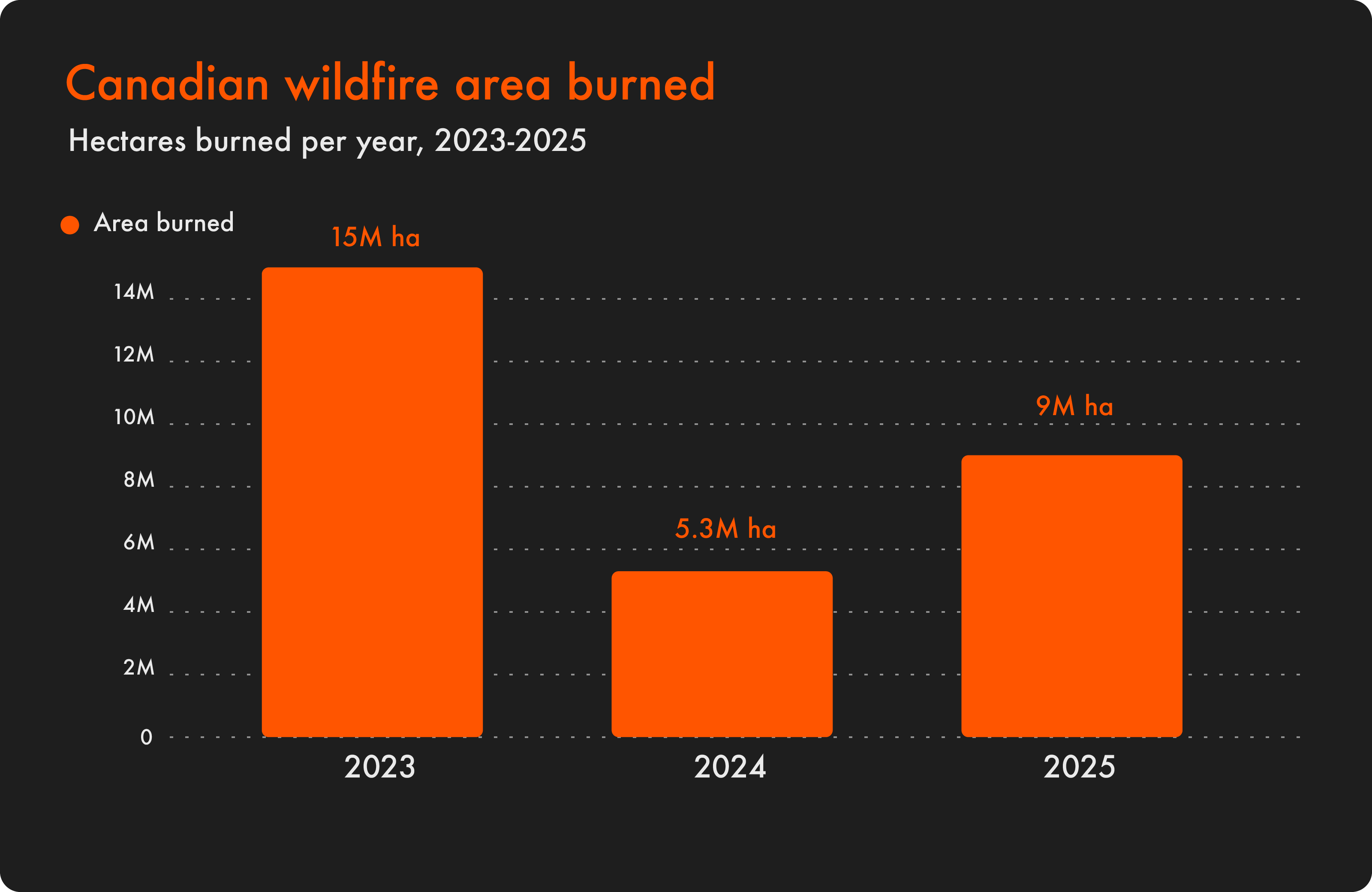
In three years, Canada has burned through nearly 30 million hectares of land — an area larger than the United Kingdom.
2023 shattered every record in Canada's history. 15 million hectares up in flames. 232,000 people were evacuated from their homes. In 2024, another 5.3 million hectares burned, including a fire that destroyed a third of the town of Jasper. In 2025, the country's second-worst season on record, nearly 9 million hectares went up, more than double the ten-year average. And 85,000 more people were evacuated, over half of them from Indigenous communities.
The workers who held the line through all of it while sleeping in fire camps, felling trees with chainsaws, coordinating helicopter drops in remote terrain, breathing carcinogenic smoke for weeks at a stretch, did the same job every municipal firefighter in the country does, possibly more.
But according to the federal government, they aren't firefighters at all.
Here's how it works. Canada's Income Tax Act gives special pension treatment to people in what it calls Public Safety Occupations — firefighters, police officers, corrections officers, air traffic controllers, commercial airline pilots, and paramedics. Workers in those categories can accrue pension at a rate of 2.33 per cent per year and retire earlier, in recognition of the physical toll and dangers of their jobs. Everyone else is capped at 2.00 per cent per year and can't draw a pension until 55.
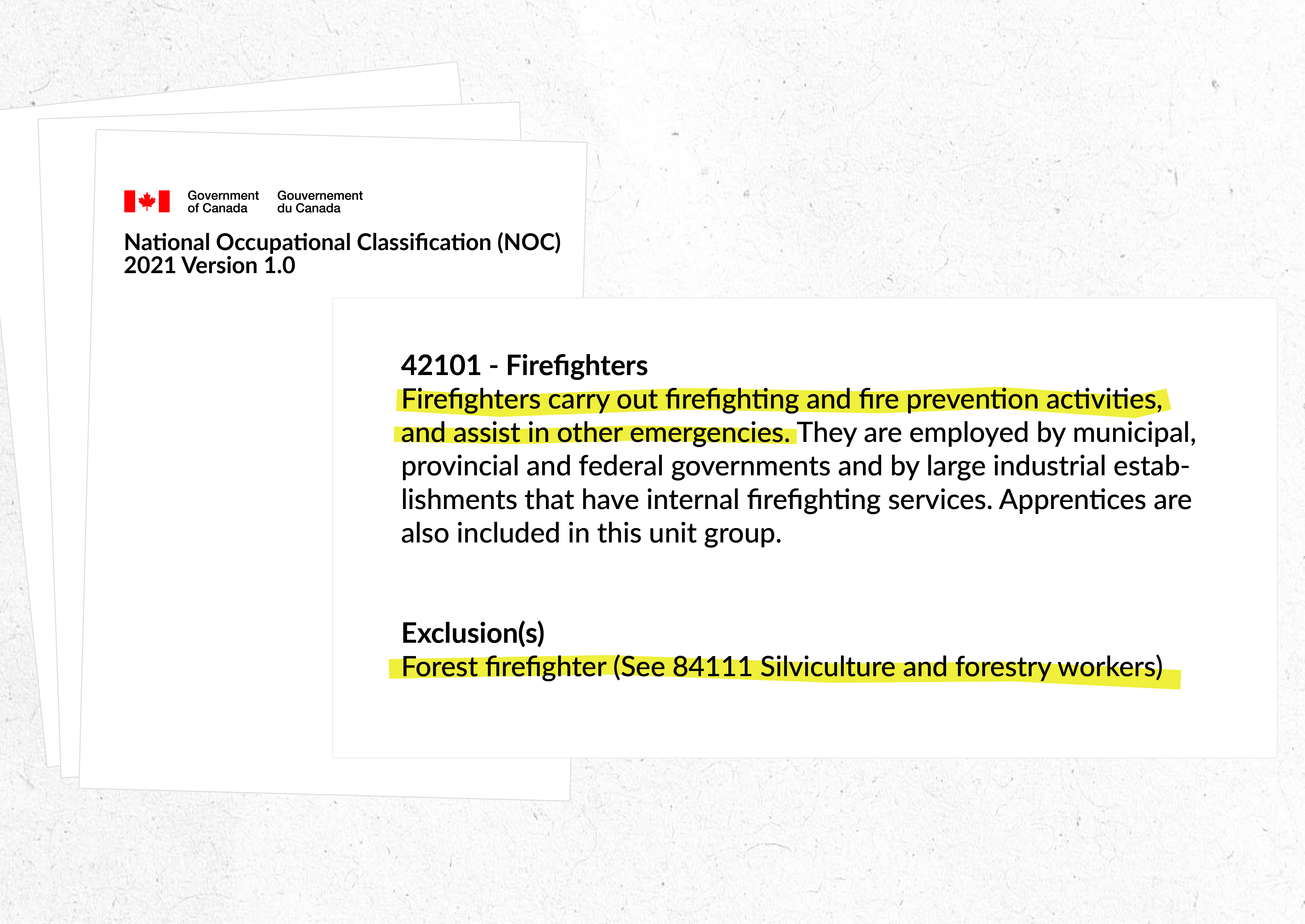
The distinction between the two groups isn't based on job duties, risk, or physical demands. It's based on a definition in a government document called the National Occupational Classification, or NOC. The federal government defines who counts as a "firefighter" — and the NOC explicitly excludes wildland and forest firefighters. Instead, it classifies them as silviculture and forestry workers.
That classification doesn't just affect federal policy. It gives employers a tool to use against wildland firefighters at the bargaining table — when workers try to negotiate pension benefits comparable to their municipal counterparts, they're told the government itself doesn't consider them firefighters.
Put the NOC's own description of a firefighter's main duties next to the actual duties of wildland and forest firefighters, and the overlap is striking. Both groups respond to emergency calls. Both control and extinguish fires using manual and power equipment. Both maintain firefighting equipment, write incident reports, educate the public on fire prevention, train to maintain physical fitness, and assist police and emergency organizations during major disasters.
Where their duties differ, it often tilts into more dangerous for wildland firefighters. Wildland firefighters respond to natural disasters including floods and landslides. They perform tree felling with chainsaws. They work in remote locations, on extreme slopes, for weeks or months at a stretch.
The employment requirements are also similar. Both require high school completion, specialized firefighting training and physical fitness standards. Yet one group can retire earlier with a stronger pension. The other has to wait with a weaker one.
The pension provisions for Public Safety Occupations exist for a reason: these are jobs that break bodies down faster than most. And wildland firefighters are no exception.
Research consistently shows that firefighters, regardless of where they fight fires, face elevated risks of cardiovascular disease, pulmonary disease, mental health conditions, and cancer. Wildland firefighters, though, may face even greater exposure to harmful substances. While a structural firefighter responds to single and sporadic events over time, a wildland firefighter can spend weeks or months continuously inhaling toxic smoke, working in hazardous conditions day after day.
And the exposure is getting worse. Climate change is driving longer, more intense fire seasons. For wildland firefighters, that means more toxic smoke, more time on the fireline, and more long-term damage to their health. Expecting them to have significantly different health outcomes from structural firefighters, given this level of sustained exposure, doesn't line up.
Things are moving, slowly.
British Columbia became the first province to negotiate earlier pensions for its wildland and forest firefighters, with changes expected to take effect in 2026. The federal government already recognizes wildland and forest firefighters it employs directly as firefighters, so wildland and forest firefighters on the federal payroll get the Public Safety Occupation designation.
Provincial and territorial wildland and forest firefighters have been unable to get the same recognition, because their employers rely on the federal NOC classification to deny them the designation.
As long as the NOC excludes forest firefighters from the definition of "firefighter," the federal tax rules that govern pension accrual and retirement age won't apply equally. These first responders at the provincial and territorial levels will keep hitting the same definitional wall. The fix has to happen at the source. The federal government has to get out of these workers' way.
This problem has a simple fix. The federal government doesn't need to pass a new law. It doesn't need to amend the Income Tax Act. It just needs to update the NOC, a classification document that it already maintains and periodically revises, to include wildland and forest firefighters in the definition of "firefighter" and remove the exclusion that currently misplaces them into the forestry worker category.
That single administrative change would extend the Public Safety Occupation designation to wildland and forest firefighters, who would then be properly recognized as firefighters, granting them the ability to access important benefits they need, including a higher pension accrual rate and an earlier retirement age that their counterparts in structural firefighting, policing, corrections, and paramedicine already have.
The issue has now reached the floor of the House of Commons.
NDP MP Gord Johns has presented Petition 451-00582, calling on the Government of Canada to immediately correct the misclassification of wildland and forest firefighters in the National Occupational Classification by recognizing them as firefighters, and to remove all federal barriers that prevent them from accessing the protections and benefits available to other firefighters and public safety workers.
The petition acknowledges that wildland and forest firefighters perform the same life-threatening public safety duties as other firefighters, that climate change is making their work more dangerous every year, and that the current classification is an inequity that has been acknowledged but not fixed. It also points out that in April 2024, the House of Commons Standing Committee on Public Safety and National Security unanimously supported action to address this problem, yet nothing has been done.
The federal government has already recognized wildland and forest firefighters employed directly by Ottawa. The question is why that recognition stops at the federal payroll. Provincial and territorial wildland and forest firefighters do the same work, face the same risks, and breathe the same smoke. They deserve the same status. Unfortunately, the NOC stands in their way.
Tell your MP the federal government needs to amend the NOC to include wildland and forest firefighters in the definition of "firefighter" and to extend the Public Safety Occupation pension provisions to everyone who fights fires, regardless of where those fires burn.
It's a simple ask. Forest firefighters have been doing the same dangerous work as their structural counterparts for decades. They deserve the same treatment as them.
The workers who held the line through endless devastating fire seasons, who stayed in the smoke for weeks, who protected communities they'd never set foot in, who came home with lungs full of carcinogens and memories they'll never shake, shouldn't have to fight their own government for the pension they've earned.
Email your member of parliament to carry out Petition 451-00582 calling on the government to fix the classification. And tell your MP: wildland and forest firefighters are firefighters. It's time the NOC caught up.